
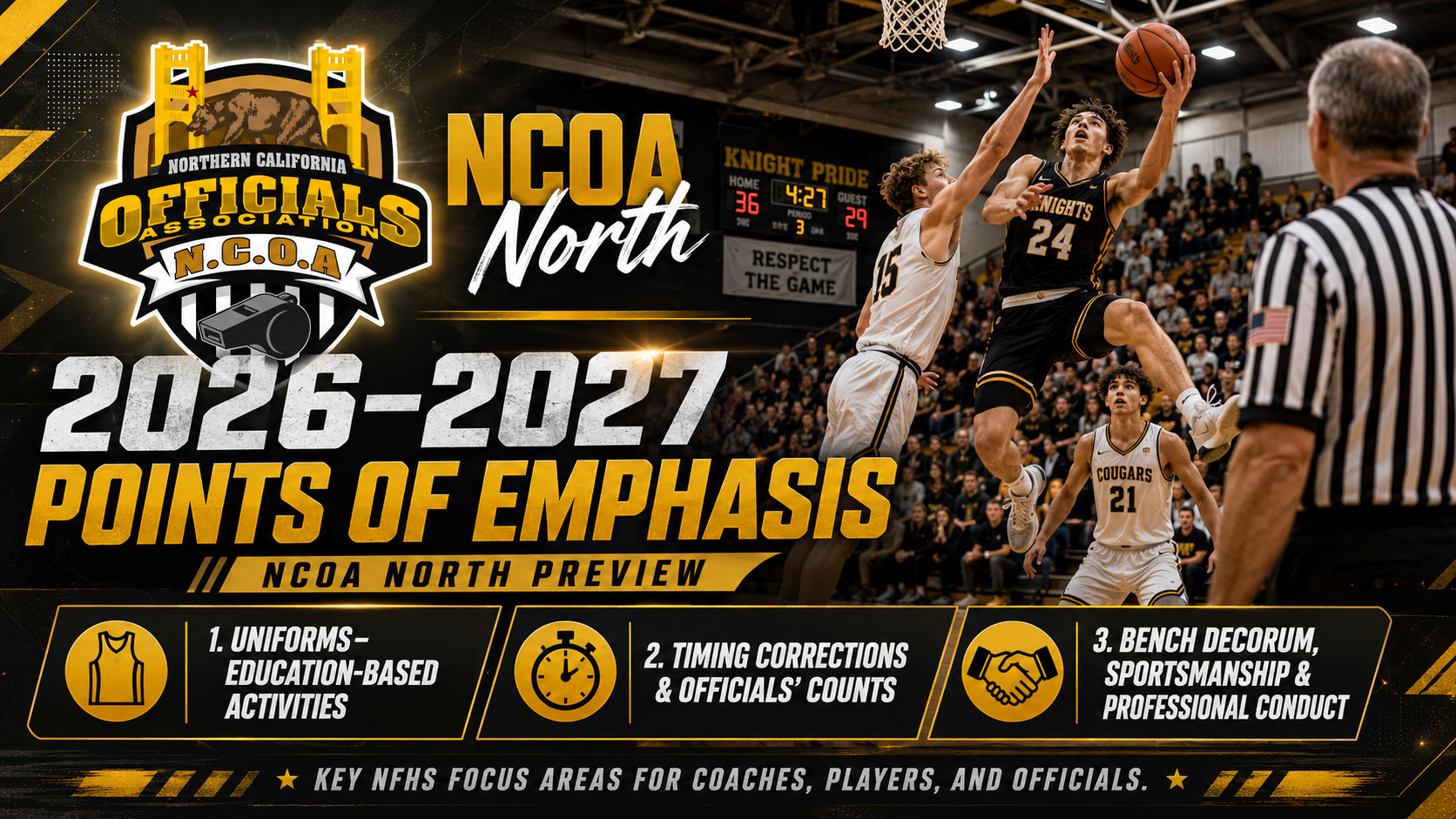
2026-27 NFHS Basketball: Points of Emphasis
Alongside this season's rule changes, the NFHS Basketball Rules Committee has identified seven points of emphasis for 2026-27. These are not new rules — they are areas where consistent, education-based enforcement protects safety, fairness, and the integrity of the game. NCOA North officials should review each before the season tips off.
Advertisement
1. Uniforms
White for home, dark for visitors. Tuck-in jerseys must stay tucked, front and back. Non-compliant players leave until corrected (Rule 3-3-4) — coaches should address it before tip-off.
2. Timing & Officials' Counts
Officials may use a visible or silent count to correct timing mistakes or equipment issues — not just backcourt, closely-guarded, and three-second calls. Communicate clearly with the table.
3. Bench Decorum & Sportsmanship
Coaches are the primary role models; the head coach is responsible for all bench conduct. Taunting, prolonged dissent, and excessive reactions must be addressed promptly and consistently.
4. Physical Play & Illegal Contact
Penalize hand-checking, displacement, and push-offs that restrict freedom of movement. Post play needs special attention: two hands on the back, forearm displacement, or dislodging a legal opponent.
5. Traveling & Continuous Motion
Euro-steps, spin moves, and jump stops are legal within the pivot rules; dragging the pivot or taking extra steps is traveling. Continuous motion ends when the ball is clearly in flight.
6. Player Equipment
Tooth and mouth protectors must be custom-fitted or molded and worn as intended. Decorative or non-protective additions are prohibited for the safety of all participants.
7. Authenticating Mark
All game balls must display the NFHS Authenticating Mark. Non-conforming equipment is reported to the state association after the contest — reinforce this at pre-game certification.
Consistent enforcement across these seven areas keeps our games safe, fair, and true to the educational mission of high school basketball. Study each point, talk them through with your crew, and set the standard from the opening tip.

Comments (0)